

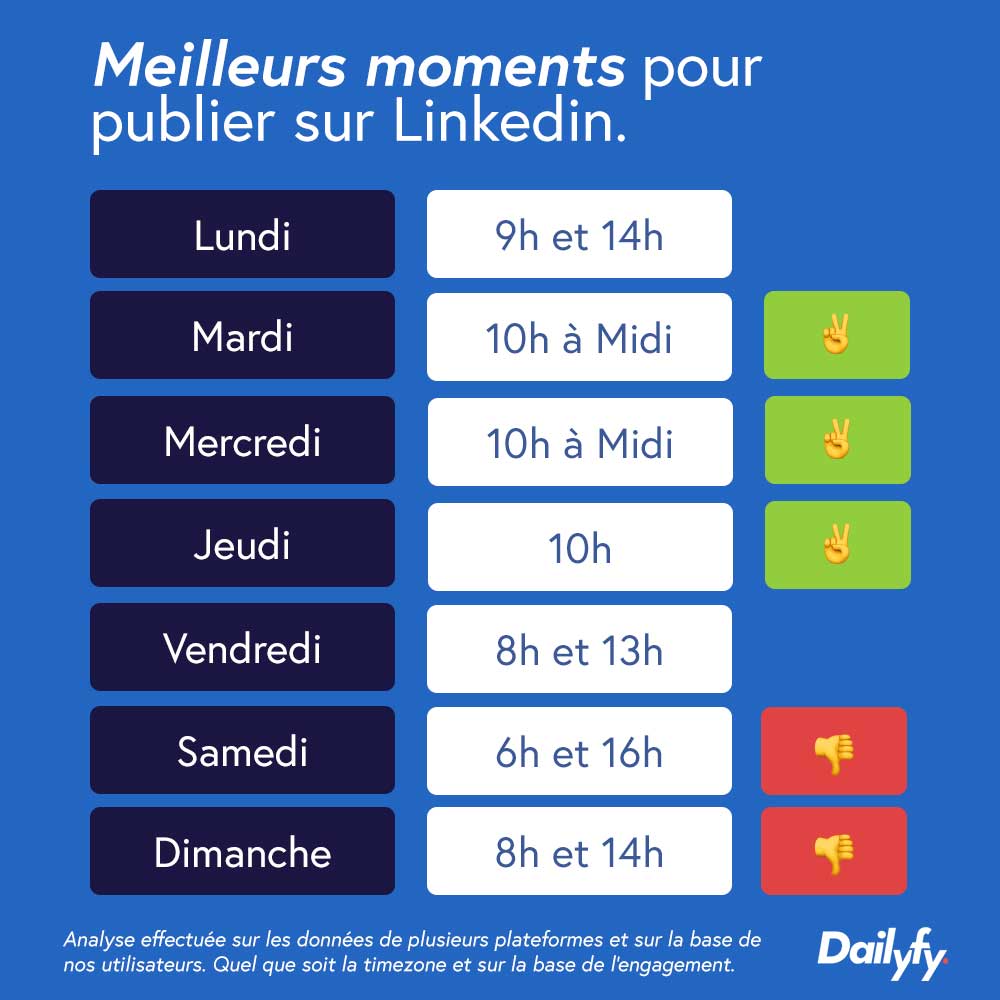
The best time to post on LinkedIn is the time that works for the people you want to reach, not a universal hour copied from a chart. The French source discussed 2024 patterns. Its retained illustrations are historical examples; the times printed on them are not certified current recommendations. Use them to form hypotheses, then test against your own results.

Which days should you test first?
Tuesday, Wednesday and Thursday can be starting candidates for an audience that follows a conventional working week. That is a planning choice, not evidence that the platform always rewards those days. Your industry, geography and the purpose of the content matter more than assuming every professional has the same routine.
Do not ban weekends or Friday afternoons automatically. Independent professionals, shift workers and international audiences may use LinkedIn differently. Likewise, a live announcement has a deadline that an evergreen explanation does not. Publish necessary information when it becomes useful rather than delaying it for a supposed perfect day.
Three time windows as hypotheses
The original guide suggested early morning, late morning and the end of the working day. You might compare 07:00–08:00, 10:00–11:00 and 17:00–18:00 in the target audience’s time zone. These are illustrative test windows, not guaranteed peaks or requirements for every account.
Choose fewer windows if your normal publishing rhythm is modest. Record the named time zone, not simply your laptop’s clock. Daylight-saving changes and audiences across countries can otherwise make identical-looking times refer to different moments. Do not assume a commute, coffee break or evening means the same thing for everyone.
Read the relevant analytics
Separate statistics for an individual post, a personal profile and a company Page. Availability and metric definitions differ. Review impressions, substantive reactions, comments and useful actions according to the purpose of the post. Profile visits and search appearances do not directly identify the best publication hour.
Look at the professional or geographic audience information available to you, without inferring private habits from a small sample. Choose a consistent observation window: comparing one post after a few hours with another after several days exaggerates differences. Record whether distribution was organic, promoted or supported by a special event.
Try a four-week comparison
Four weeks can be an organisational starting point, not a guarantee of statistical certainty. In the first week, define the goal, candidates and current baseline. During the next weeks, alternate reasonably comparable topics and formats across those candidates. Review the record at the end instead of changing the rule after every post.
Avoid always assigning your strongest topic to the same hour. Rotate where feasible, document holidays and note unusually large mentions or external publicity. If there are too few comparable posts, continue observing. One viral result or one quiet week cannot settle the question for every future campaign.
Keep content and frequency in the decision
Text, multi-image posts, documents and video require different levels of attention. Compare like with like before attributing everything to timing. An introduction that explains the value, readable media and an accurate claim remain important regardless of the selected hour.
Choose a rhythm your team can sustain while answering relevant questions. More frequent publishing is not automatically an algorithm hack. A lighter end-of-week topic can be appropriate for some audiences, but it is an editorial choice to test, not a mandatory rule.
Turn findings into a workable calendar
Use Dailyfy to organise compatible posts, prepare review and schedule in the intended time zone. Treat suggested slots as assistance rather than a reach guarantee. Plan who will respond after publication, keep the test notes and revisit your conclusions when audience, season or offer changes. The useful result is a repeatable method, not a permanent best hour.