
Your LinkedIn professional brand is not a follower total or repeated slogan. It is what people understand about your expertise, when you can help and which evidence makes your claims credible. This 2027 edition offers a positioning and relationship method rather than a general platform tutorial. Sources were checked on 20 November 2026; no future change or business result is guaranteed.
Choose a specific place in the right audience's mind
Identify whom you want to help and the decision they are trying to make. “I talk about management” is too broad to guide content. “I help technical team leaders prepare difficult conversations” offers a more concrete scope. This is not a magic formula, but a filter helping readers recognise whether your work fits their situation.
Write a positioning sentence covering audience, problem, method and limits. Illustrative example: “I help small industrial teams document procedures through on-site workshops, without replacing their safety responsibilities.” Limits add precision. Expand later if experience justifies it; begin with a promise you can genuinely fulfil and explain.
Make the profile a summary, not a set of superlatives
Your headline should make the work understandable without opening a dossier. The introduction explains problems addressed, working approach and contexts. Experience shows what you actually did with verifiable details. Photograph and banner support that reading but cannot replace a clear offer or evidence of ability.
The official LinkedIn profile guidance treats the profile as a professional presentation space. Use it as an entrance to your work and check consistency between headline, introduction and recent experience. Avoid unsupported adjectives such as “leading” or “best expert”. A reader should be able to restate your contribution without guessing through fashionable terminology.

Build a proportionate evidence library
Evidence can be an explained method, anonymised deliverable, reasoned decision or specialist publication. It must show something specific. A dashboard screenshot without period, context or definitions does not establish your contribution. When sharing results, explain role, scope and limitations. Do not claim an entire team's work or turn correlation into causation.
Create an evidence card with starting situation, personal action, observable result, sharing permission and limits. Properly anonymise confidential information or use a clearly labelled fictional example. Never invent a customer recommendation to fill a gap. An honest explanation of an unresolved problem may be more instructive than a spectacular context-free success. Check portfolio links and remove material that no longer represents your work.
Connect skills with concrete situations
Choose skills relevant to your current positioning, then find where experience and content demonstrate them. A long list disconnected from your work makes understanding harder. Separate skill, tool and sector: using software alone does not explain the ability to solve a complex situation. Prefer a few clear connections to an impressive-looking inventory.
LinkedIn explains how to add and remove skills. Our editorial recommendation is to connect each priority skill to a real example, without claiming that this guarantees opportunities. The table helps organise evidence. It is not an official LinkedIn score or occupational ranking; adapt it to your experience and the audience's questions.
| Positioning to demonstrate | Possible evidence | Limit to clarify |
|---|---|---|
| Interview preparation | Explained anonymised framework | Not a substitute for legal advice |
| Supplier analysis | Documented criteria and trade-off | Comparison context and scope |
| Technical documentation | Authorised procedure excerpt | Personal role and specialist approval |
Publish to reveal your reasoning
Choose three lasting angles: a frequent question, a methodological decision and an important professional limitation. Useful content shows how you think, not just what you assert. Describe the situation, options considered and reasons for choosing. A reasoned comparison or explained mistake can demonstrate expertise without making every post a success story.
Illustrative procurement-consultant example: one post explains when unit-price comparison misleads, another presents supplier-assessment criteria, and a third describes what a quick audit cannot establish. All reinforce the same positioning without recycling a general procurement definition. You need not comment on every trend: choose those where experience contributes a useful distinction.

Feed updates do not replace brand strategy
In its 12 March 2026 announcement, LinkedIn describes a more personalised feed and action against generic content, artificial engagement and automated comments. This is not a visibility formula. Our advice is to invest in viewpoint and evidence instead of wording designed only to trigger reactions.
Do not infer that one format always wins, that every external link is penalised or that a certain like count guarantees distribution. Choose format for the work shown: text for a decision, document for a framework, video for a gesture. A closing question helps when it opens a real discussion; “comment to agree” does not demonstrate expertise.
Develop relationships before asking for business
Identify professionals with whom there is a credible reason to exchange: peers, people facing similar problems, complementary partners or contacts met elsewhere. Read their work. A useful comment adds nuance, relevant experience or a precise question. Replacing a generic compliment with a longer compliment is not enough to establish a professional relationship.
When proposing a connection, honestly explain context if a message option is available. Do not immediately convert acceptance into automated selling. Respond to discussions you start and accept silence. Illustrative example: after a shared webinar, offer a resource answering a question without assuming buying intent. The relationship may remain a professional exchange, which is already worthwhile.

Set a rhythm compatible with real work
Leave room in the calendar for collecting examples and checking facts. Allocate time to record questions, draw a lesson, review sensitive information and answer comments. There is no mandatory frequency for every profession. A sound post at a sustainable pace is better than an impossible daily commitment filled with generic material.
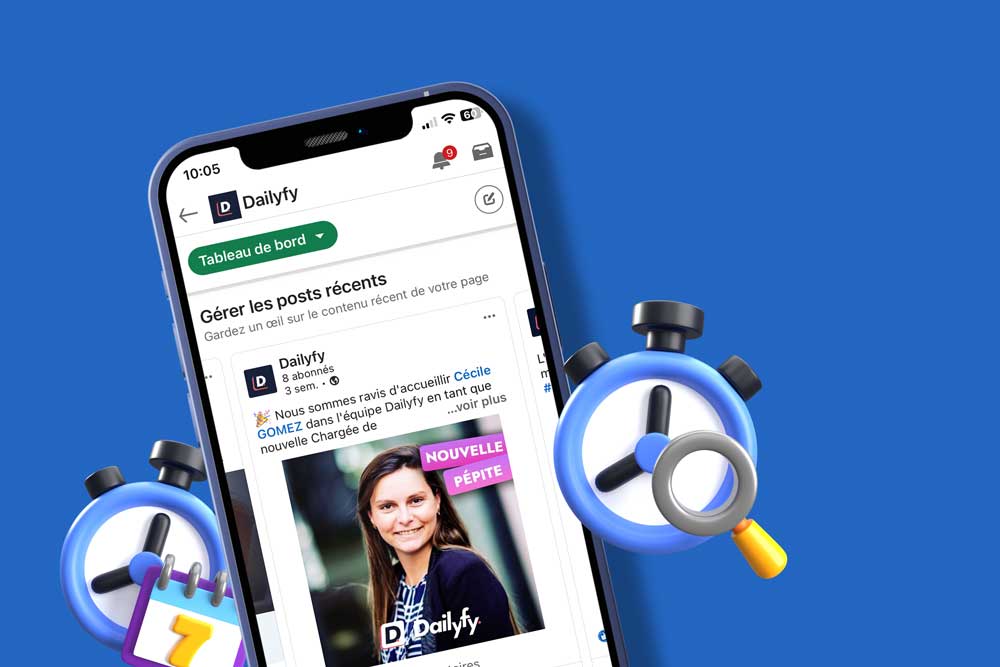
Dailyfy's calendar view can organise preparation. It does not replace personal approval or authorise relationship automation. Seek review where examples involve clients, colleagues or sensitive data. Keep a small reserve of lasting expertise-based topics without manufacturing seasonal occasions or publishing simply to occupy the feed.

Measure recognition and conversation quality
Define what to observe: understanding of your speciality, enquiries matching your scope, peer conversations or relevant invitations. Impressions describe distribution, not authority. Followers alone do not establish audience fit. Record questions and what people actually remember about your work.
Compare content using consistent periods and definitions. Supplement available data with a simple log: topic, evidence, intended audience, useful exchanges and possible next steps. Our social KPI framework helps structure this. Do not make a score or isolated rate a career promise. A less visible post may create a more relevant conversation than broad generic content.

A practical work plan and consistency review
Rewrite your positioning, choose three pieces of shareable evidence and check the profile. Prepare a short series explaining your reasoning, then identify relationships to maintain without immediate sales objectives. After a cycle suited to your work, review responses: does the audience associate you with the intended topic, understand examples and ask questions that refine your angle?
Before publication, check accuracy, confidentiality, attribution, tone and fit with positioning. For supported publishing workflows, consult Dailyfy's LinkedIn integration; for organisation, the community manager workflow; for inconsistencies, social communication mistakes. Your brand grows through alignment between what you say, the work you show and relationship quality.