
Introduction: prepare a useful LinkedIn strategy for 2027
LinkedIn can support a career, a specialist reputation or business development. Those goals overlap, but they do not call for identical profiles or posts. Start with the people you want to help and the action you want them to take. A large audience is not automatically a relevant one.
This 2027 planning edition uses information available in November 2026, not promises about future product changes. Work through four levels: establish a credible profile, publish useful content, develop relationships, then organise a measurable strategy. You can begin at the level that matches your current practice.
Level 1: build a credible profile
Set up the essentials
Write in your clients’ working language and consider an additional profile language for international audiences. Check public visibility if you want your profile discoverable outside LinkedIn. Where available, choose whether following or connecting should be the primary action. Keep useful comment, mention and message notifications, and review your profile and posts on a phone.
For recruitment, explain your experience and target roles. For personal branding, make your expertise clear. For business development, connect that expertise to an audience’s problem. The same profile can serve several purposes, but visitors should understand its main purpose quickly.
Photo, banner and headline
Choose a recognisable portrait with a simple background. Use the banner to clarify your activity, intended audience and a genuine proof point. Keep essential text readable on mobile and check LinkedIn’s current image requirements before exporting artwork.
Your headline appears beyond your profile, including alongside contributions. A useful writing framework is: “I help [audience] achieve [outcome] through [expertise].” For example, helping local authorities organise their social communications describes a service more clearly than an unexplained job title. This is a writing example, not a customer testimonial or a promised result.
About, experience, skills and Featured
Open the About section with your audience’s problem. Explain what you do, support it with verifiable results, briefly introduce your background and provide a contact route. The preview length varies by display; put the essential message first and respect the editor’s current character counter.
Describe experience through responsibilities and outcomes rather than copying job descriptions. Add relevant skills and naturally occurring professional keywords. Where available, use Featured for a useful post, case study or website. Do not disclose confidential client information or invent results to fill the page.
Profile checklist: a clear portrait and banner; a meaningful headline; an About section with a next step; a personalised profile URL; relevant experience; selected work; and genuine recommendations. Ask people who know your work instead of trading formulaic endorsements.
Level 2: publish content people can use
Choose two or three editorial pillars
Select a manageable set of subjects that connects your expertise to readers’ needs. An agency might cover client workflows, platform changes and documented case studies. Pillars provide editorial consistency; they are not a rule requiring you to avoid every other subject.
Match the format to the idea
Text suits an opinion or lesson. A PDF document can organise a checklist or tutorial. Native video can demonstrate a process or show behind-the-scenes work. A photograph can introduce a team or event. A newsletter supports recurring, deeper coverage when your account is eligible. A poll is useful when the question genuinely helps you understand your audience.
No format guarantees superior reach. Newsletter notifications depend on the product and recipients’ settings, and notification does not mean reading. Assess formats against the objective, production effort and audience response rather than a universal ranking.
Write a readable post
Use the opening lines to establish a concrete situation, question or fact. Develop one idea with short paragraphs, give an explanation or usable method, and finish with a sincere invitation to discuss when appropriate. Avoid manufactured suspense and requests for empty comments.
Five reusable structures are a lesson learned, a step-by-step method, a reasoned disagreement, a documented case study and a behind-the-scenes decision. Fill these structures with your own experience. For a case study, explain context, action and outcome, obtain permission where necessary and distinguish observed results from speculation.
Use the current editor limit for text posts; a shorter draft often makes editing easier. A range such as 800–1,500 characters can be an exercise, not a proven optimum. Move complex explanations into a document, article or newsletter when that serves the reader better.
Find a sustainable publishing rhythm
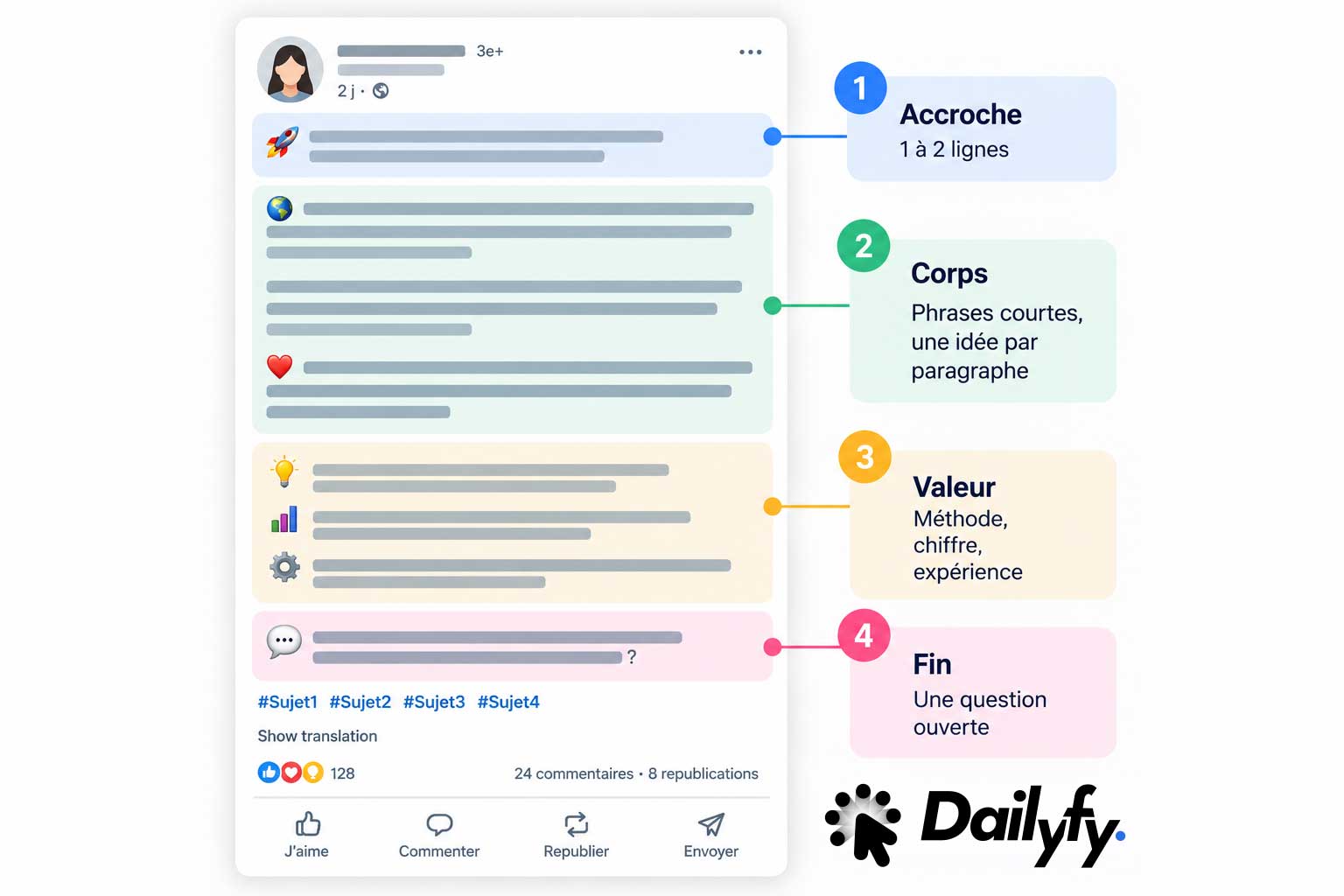
Three weekly posts can be a starting example if you can sustain their quality. Do not sacrifice relevance to meet a quota. Test audience-local time windows, use comparable formats and observe each post for the same period. A weekday morning is a hypothesis, not a universal best time. The French infographic retained with this guide illustrates post structure, not a guaranteed ranking formula.
Understand the feed without inventing an algorithm formula
LinkedIn’s March 2026 engineering explanation describes complementary retrieval and sequential-ranking systems using content, profile context and previous interactions. This is more nuanced than one model replacing every signal. The system is personalised; public explanations do not provide a fixed points table for each reaction.
Reading, saves, substantive comments and relevant sharing can help evaluate usefulness where those metrics are available. Do not claim that thirty seconds of reading equals fifty likes or that one metric determines distribution. Your role is to make the content worthwhile for a specific reader.
Avoid engagement pods, automated comments, repetitive outreach and low-effort generic content. LinkedIn’s 2026 explanation of AI slop distinguishes useful AI assistance from repetitive material with little substance. A report is not proof that every AI-assisted post will be penalised. Review accuracy, examples and tone before publication.
There is no universal rule here that every external link must go in a comment. Put a link where it helps the reader, test outcomes and measure actual visits where possible. Similarly, do not assume a company Page is automatically penalised or that a personal profile always performs better.
Level 3: develop relationships and engagement
Build a relevant network
Connect with potential clients, peers and people whose work you genuinely follow. Personalise an invitation with a shared context rather than sending a pitch immediately. Use a professional tone appropriate to the recipient and country. A connection or follow is not blanket consent to repeated sales messages.
Identify a small group of useful accounts and allow time for meaningful comments. Add an example, a thoughtful question or a reasoned difference of opinion. A daily fifteen-minute routine is an optional organisational aid, not an algorithm requirement. Respond to legitimate comments on your own work; availability supports conversation without guaranteeing a first-hour boost.
Combine people and the company Page
The Page provides official information, offers, hiring news and company updates. Leaders and employees can contribute their own experiences and perspectives. Encourage voluntary, authentic participation rather than requiring identical reposts or coordinated artificial engagement.
Personal branding combines a clear positioning, repeated evidence of expertise and a recognisable editorial style. Ask what a contact would say when recommending you in one sentence. If that answer is unclear, improve the positioning before increasing output.
Approach social selling as a conversation
Observe a prospect’s public needs, contribute usefully, connect with relevant context and ask about their situation. Share a resource when it helps. Suggest a meeting only when there is a genuine reason. Avoid mass messaging and automation that can damage trust or trigger restrictions.
Level 4: organise and measure the strategy
Choose an objective and build a calendar
Select a primary objective: awareness, qualified enquiries, recruitment or employer reputation. Plan at a monthly level. An illustrative week could combine a Monday method document, Tuesday behind-the-scenes photo, Thursday opinion and Friday case study. Adjust this to your capacity rather than treating four posts as mandatory.
Dailyfy can help prepare content, organise a shared calendar and obtain client or manager approval before publication. Use scheduling suggestions as planning support, not a guarantee of reach. Keep responsibility for factual checks and approval with the team.
Measure what the objective requires
Distinguish impressions from unique people reached. For engagement rates, keep the denominator consistent. Where available, examine saves, shares, profile visits and relevant follower growth. Track qualified enquiries and meetings separately from likes. A change in bookings cannot automatically be attributed to one LinkedIn post.
Review comparable periods and formats, keep paid and organic results separate and account for small samples. A monthly review should guide another test, not cause a complete strategic reversal after one weak post.
Develop the programme responsibly
A newsletter can deepen a recurring subject when eligibility and editorial capacity allow. Thought Leader Ads can promote eligible member content with the creator’s permission through LinkedIn’s advertising tools. Do not assume every post or member qualifies, or that this guide promises LinkedIn advertising management inside Dailyfy.
Benchmark competitors’ public subjects, formats and rhythms to identify useful gaps. Public information does not reveal their private leads, spend or return on investment. Batch production can save time, but each post still needs an authentic example, verified claim or original perspective.
Keep the company Page description, specialties and contact links accurate. Use action buttons, career information and highlighting options where your Page has access. Product availability varies, so check the current interface rather than assuming every feature is included.
A practical 90-day plan
Days 1–7: complete the profile checklist and establish a baseline. Days 8–30: build a sustainable publishing and conversation routine. Days 31–60: compare text, document and video examples under reasonably similar conditions. Days 61–90: review results, refine pillars and consider a newsletter only if it serves the objective. This is a work plan, not a promise of results within ninety days.
Eight mistakes to avoid
An unclear profile; subjects disconnected from a reader need; publishing without participating; unchecked generic AI copy; links placed without considering usefulness; judging success only by likes; ignoring the complementary role of people and the Page; and abandoning the strategy before gathering meaningful evidence. Fix the weakest link before simply producing more.
Turn the plan into a routine
Improve the profile this week, define your pillars this month, reserve realistic time for useful conversations and review results regularly. Dailyfy brings planning, collaboration, approval and performance review together. It supports consistent work without replacing expertise or promising a particular business outcome.
Frequently asked questions
How does the LinkedIn algorithm work in 2027?
Use the documented systems available today as your starting point. Content relevance, profile context and interaction history inform personalisation, but there is no public fixed formula and future 2027 changes cannot be guaranteed.
How should I publish effectively?
Make the opening clear, offer a useful explanation or experience, format for mobile and check facts. Invite a real discussion where appropriate and respond thoughtfully rather than asking for artificial engagement.
What is the best time to post?
There is no single best hour for every account. Test time windows in your audience’s time zone with comparable content and equal observation periods. Use sufficient evidence before choosing a routine.
Should I use hashtags?
Use relevant labels if they help identify the subject. Avoid unrelated tags and do not expect a specific number to guarantee distribution. Clear content matters more than treating hashtags as a shortcut.
Can AI help write posts?
Yes: for ideas, structure or editing. Check every claim, preserve your own experience and remove generic filler. AI assistance is not the same thing as low-quality automated content.
Should I prioritise a Page or a personal profile?
Give each a role: official company information for the Page, personal expertise and conversations for people. Choose the balance according to your goals and resources, not a universal reach claim.
How long until I see results?
That depends on your starting point, audience, objective and resources. Set a review period and measurable indicators, then adjust using sufficient observations. Neither a fixed three-month nor six-month result is guaranteed.