

Social media moderation is not a clean-up operation intended to remove disagreement. It is a method for protecting people, making conversations useful and routing requests to the right owner. An effective team knows what to answer, review, escalate or protect, and can explain its decisions.
This 2027 edition provides an operating framework based on sources checked on 20 November 2026. It predicts no future features and does not replace legal advice for your situation. Categories, sample replies and review schedules are organisational recommendations, not universal obligations.
Define scope before choosing software
List the accounts, languages, hours, comments, messages and reviews your team can handle. Add actual permissions: reading, replying, hiding, deleting or reporting where supported. Publishing access does not mean a third-party tool can access every conversation. Test coverage before promising it.
Your objectives may include harassment protection, questions, complaints and spam reduction. They are not interchangeable. A negative message may provide useful information; a polite sentence may conceal fraud. Decide from content and context rather than a sentiment label alone.
Combine five methods instead of seeking one solution

| Method | Purpose | Caution |
|---|---|---|
| Pre-moderation | Review before visibility where supported | Staff the approval queue |
| Post-moderation | Check visible conversations | Initial exposure remains possible |
| Reactive | Examine reports | A report is not proof |
| Hybrid | Combine filters with human review | Track errors and corrections |
| Community participation | Make member alerts easier | Retain organisational responsibility |
Pre-moderation can reduce exposure but delays legitimate questions if nobody checks the queue. Post-moderation needs coverage suited to your activity, not unrealistic permanent-availability promises. Reports complement regular checks rather than replacing them. Community involvement should produce alerts, never invitations to pursue or humiliate someone.
Consult YouTube comment settings and TikTok comment management to verify available filtering options. Do not assume settings transfer between networks. Labels and eligibility may differ; record where your internal procedure was tested.
Write rules that distinguish disagreement from abuse

Explain accepted behaviour and intervention grounds: targeted insults, harassment, threats, exposed personal information, spam or fraud. State that reasoned criticism and complaints remain welcome. Useful rules provide understandable examples rather than vague permission to remove anything uncomfortable for the brand.
Provide a contact or appeal route where you can support one, alongside response hours. For disputed decisions, retain the applied rule and necessary context. Consistency does not mean identical sanctions regardless of circumstances: someone correcting a mistake and an account organising harassment need not receive the same treatment.
Triage conversations with a simple matrix
At first reading, ask whether someone is at risk, whether a response or action is expected, and who has the information required. A short matrix supports backup staff and reduces improvisation. These example priorities should be adapted to your coverage and sector.
| Category | Initial action | Owner |
|---|---|---|
| Routine question | Verify and answer clearly | Editorial or service team |
| Complaint | Acknowledge and open follow-up | Case owner |
| Suspected spam or fraud | Check rules and protect if needed | Authorised moderator |
| Exposed personal information | Limit exposure with available controls | Privacy contact |
| Threat or serious risk | Activate the relevant protocol, without public debate | Security lead or competent contact |
Keep only necessary information in a case record. An internal reference may be enough for customer-service follow-up. A CRM transfer requires a real integration, appropriate permissions and a clear purpose; “centralisation” is not permission to copy all messages everywhere.
Answer the need, not merely the tone
A starting reply can acknowledge the request, state what is known, propose the next action and give a realistic update point. For example: “We understand your difficulty obtaining the document. We are checking availability with the relevant team. Please use our secure contact channel for case-specific follow-up.” Adapt the wording: an unrelated template often feels evasive.
Never request addresses, order numbers or sensitive details publicly. Moving to a private message does not automatically make a channel appropriate; direct people to your secure procedure. Where possible, return to the public thread with useful information that reveals no private details, rather than leaving visible questions unresolved.
Keep human judgement for ambiguous cases
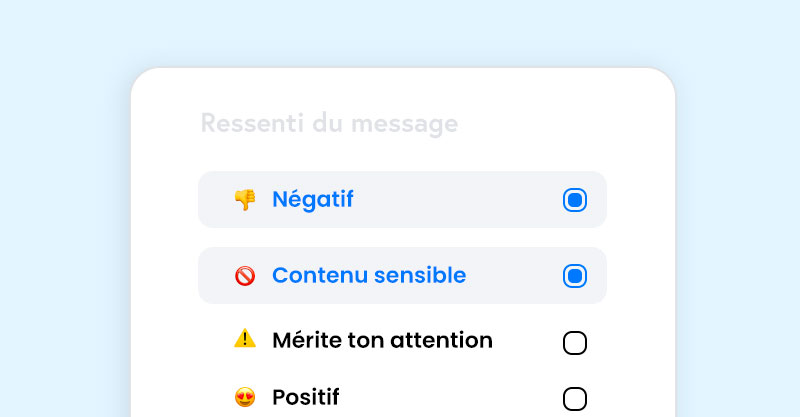
Keywords, rules and AI assistance can flag material for review. They do not prove intent or illegality. Someone may quote a harmful term to condemn abuse, while irony may be mistaken for approval. Sentiment analysis may help organise a queue, not independently decide deletion.
Test new rules against suitable anonymised examples, then review both wrongly blocked questions and missed problems. Assign responsibility for restoring legitimate content and revising filters. Do not describe predictive analysis as certain knowledge of future behaviour. Automation without a correction route simply relocates risk.
Prepare escalation and team handovers
Specify who can pause publishing, contact leadership, verify a technical allegation or request legal advice. For threats or potentially unlawful content, follow your relevant protocol and contact competent people. Avoid publicly characterising a person or act without verification. Preserve necessary evidence proportionately without redistributing harmful material.
A handover should state source, time, context, completed actions, owner and next step. “Escalated” does not mean “resolved”. Cover open cases and promised replies during shift changes. Include these handovers in your community manager workflow instead of treating them as invisible interruptions.
Choose tools around the actions required
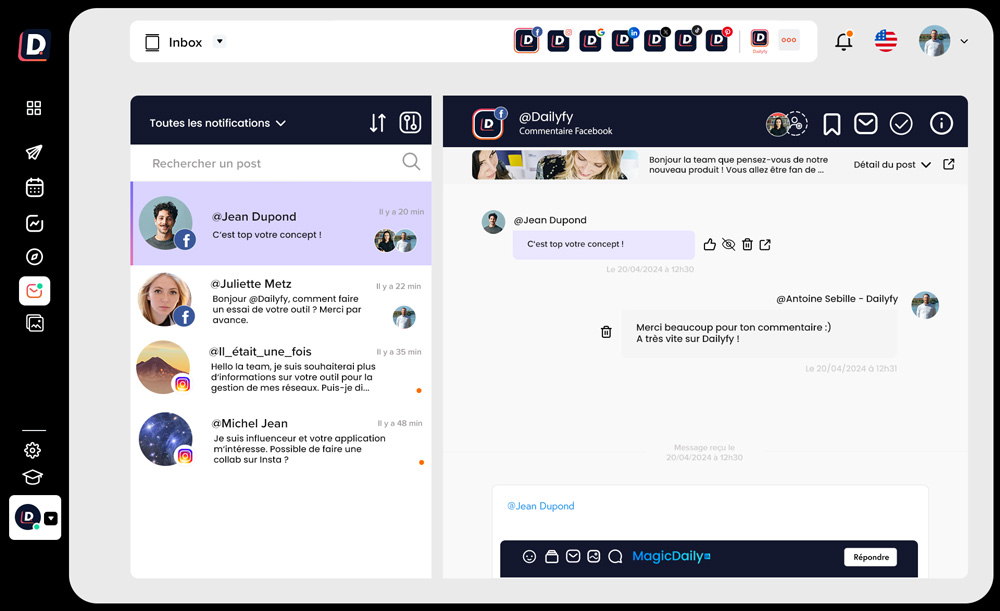
An inbox handles supported conversations; listening searches accessible mentions; a CRM follows customer cases. These scopes do not automatically replace one another. Compare tools using a real scenario: find a conversation, assign someone, inspect context, perform the permitted action and verify the result natively.
Dailyfy moderation supports compatible conversations depending on platform and subscription. Do not assume every native action is available. X concerns publishing, not X moderation or analytics; planned Ads functions are unavailable. Document a native-interface fallback for missing access.
Protect data and the people moderating
CNIL explains data minimisation and limited retention. Work with the appropriate adviser to determine what to retain, why, for how long and with whose access. A moderation screenshot can contain personal information itself. Do not build an unlimited archive for convenience.
Train moderators in rules, relevant languages and de-escalation. Provide breaks, handovers and someone to contact after distressing material. A stricter filter alone cannot correct every error: workload, contradictory instructions and missing support can also undermine decisions.
Audit quality, not removal counts

Review samples of replies and decisions: unanswered requests, reopened cases, useful alerts, disputed removals and false-positive corrections. Define response times around service hours; an average can conceal long-abandoned cases. The social KPI framework helps clarify periods, formulas and denominators.
- Rules are accessible and legitimate criticism remains possible.
- Every queue and escalation has an owner.
- Filters have review and correction procedures.
- Replies do not request sensitive information publicly.
- Escalated cases have a tracked next action.
- Retention and access are governed.
End each audit with one concrete change: clarify a rule, practise an ambiguous case, correct a reply or improve coverage. The objective is not to promise an incident-free community, but to make moderation more consistent, explainable and sustainable.